
By The NinthEdge Team | November 2026
Picture a manager who comes back from a leadership program with a clear commitment. She is going to disagree more openly, because the program made a strong case that constructive conflict makes teams better. In her first meeting back, she challenges a senior leader’s plan. The room goes quiet. Nobody says anything about it.
A few weeks later she notices who got the next big assignment. It wasn’t her.
She has now been through two leadership programs. Only one of them was on the calendar.
Every organization has a leadership-development system
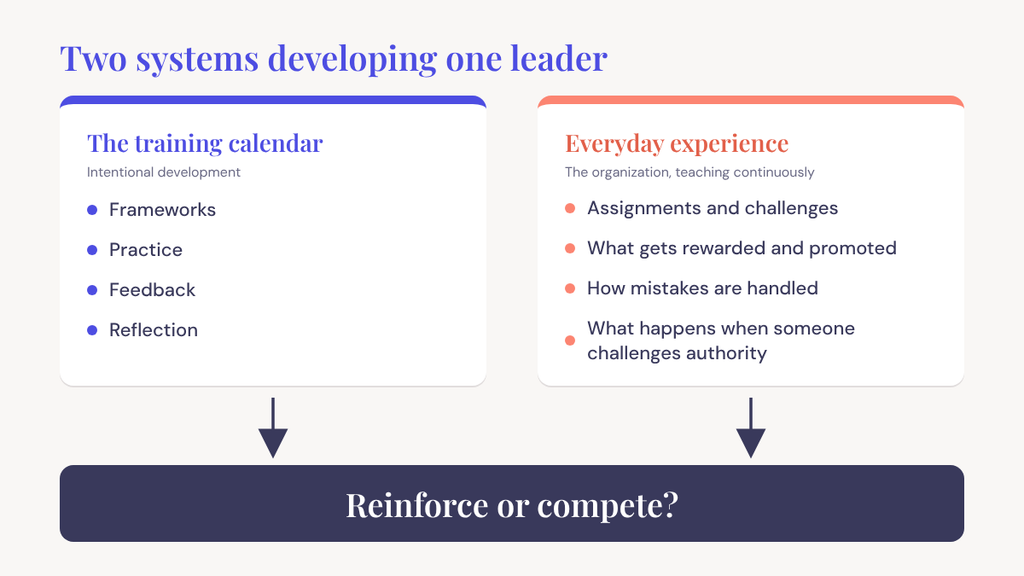
Only part of it appears on the training calendar. The rest runs through everyday experiences: the assignments people receive, the challenges they run into, the behaviors that get rewarded, who gets promoted, how mistakes are handled, and what happens when someone challenges authority.
Formal leadership development is an intentional part of that system. It introduces frameworks, creates room to practice, provides feedback, and helps people try new ways of operating. But the organization is teaching continuously, too. The question worth asking is whether those two sources of development are reinforcing each other or working against each other.
None of this is new, and we don’t want to present it as if it were. There is a substantial research foundation behind it. Three bodies of work stand out.
Experience teaches, but not automatically
In 1988, McCall, Lombardo, and Morrison of the Center for Creative Leadership published The Lessons of Experience, a study of the experiences that produced lasting changes in how executives led. One of the more interesting findings concerned hardship and challenge. Development often came from an adaptive response to difficult circumstances.
But difficulty alone doesn’t guarantee growth. What people learn depends partly on the support, feedback, and opportunities surrounding the experience. That puts leaders in a particular role: developmental partners, not just providers of training. Sometimes the job is to challenge. Sometimes it’s to support. Sometimes it’s to step back and let someone work through the difficulty.
Organizations reproduce what they reward
Benjamin Schneider’s attraction-selection-attrition research helps explain how organizations reproduce particular characteristics over time. They tend to attract, select, promote, and retain people who fit their prevailing expectations.
That raises an uncomfortable question. Are we developing the leadership behaviors the organization says it values, or the behaviors its systems actually reward?
Learning has to land somewhere
Baldwin and Ford’s 1988 review of training transfer looked at trainee characteristics, training design, and work environment as the forces shaping whether learning shows up on the job. Later meta-analyses have kept pointing to the same conclusion: the work environment, opportunities to apply what was learned, reinforcement, and feedback all influence whether learning becomes sustained behavior.
That matters even more for leadership, because the behaviors being developed depend so heavily on organizational context. Speaking candidly, delegating, or giving hard feedback all land differently in different cultures.
This is not an argument against leadership programs
It would be easy to read all this as another case for why leadership training doesn’t stick. That’s familiar territory, and it misses the more interesting opportunity.
A 2017 meta-analysis in the Journal of Applied Psychology, covering 335 independent samples, found that leadership training can improve learning, on-the-job behavior, and organizational results. Programs did better when they used a needs analysis, built in feedback, and gave people real practice. Well-designed development works.
So the question isn’t whether leadership development works. It’s whether we are connecting intentional development with the environment in which people actually lead.
Competing developmental messages
Consider an organization that teaches constructive conflict but rewards agreement with senior leadership. Or one that encourages accountability in its programs but punishes the people who surface problems.
Those contradictions aren’t simply training-transfer problems. They’re competing developmental messages, and people tend to believe the lesson that comes with consequences. When the two sources reinforce one another, development has a better chance of becoming sustained behavior. When they contradict each other, people receive two lessons and have to decide which one to follow.
The influence runs both ways
Formal programs can prepare people to take on challenging experiences more effectively. They offer language, practice, perspective, and a chance to reflect. The organization then supplies the environment where those capabilities get exercised, tested, reinforced, and sometimes discouraged.
It also works in the other direction. People return from development experiences with new expectations, new behaviors, and new ways of thinking, and those can begin to change the organization’s existing norms. A manager who names a tradeoff plainly, a team that starts asking for feedback, a leader who admits an error out loud: each one shifts what the system teaches the next person. Programs built around the real work and real decisions people face give that influence somewhere to land.
Four questions worth examining
If you want to see how development actually happens in your organization, start with what the system is teaching today:
- Promotions. Look at the last few people who moved up. What did they have in common, and is it what your leadership model says matters?
- Mistakes. When someone surfaces a problem, what happens next, to the problem and to the person?
- Challenge. When someone disagrees with a senior leader, what is the visible result?
- Assignments. Where do your people get their hardest stretch work, and who supports them through it?
Then pick one behavior your program teaches and ask whether those four answers reinforce it or cut against it.
We’d like to hear what you find. What are your leaders learning in development programs, and what is your organization teaching them when they return to work? Reach out through ninthedge.com/contact.
Sources: McCall, M. W., Lombardo, M. M., & Morrison, A. M. (1988). The Lessons of Experience: How Successful Executives Develop on the Job. Lexington Books. Schneider, B. (1987). The people make the place. Personnel Psychology, 40(3). Baldwin, T. T., & Ford, J. K. (1988). Transfer of training: A review and directions for future research. Personnel Psychology, 41(1). Blume, B. D., Ford, J. K., Baldwin, T. T., & Huang, J. L. (2010). Transfer of training: A meta-analytic review. Journal of Management. Lacerenza, C. N., Reyes, D. L., Marlow, S. L., Joseph, D. L., & Salas, E. (2017). Leadership training design, delivery, and implementation: A meta-analysis. Journal of Applied Psychology, 102(12), 1686-1718.

Work Doesn’t Just Produce the Work. It Produces the Worker.
In almost every planning conversation we’re part of right now, someone asks a version of the same question: Can…

The Measurement Problem: Why Leadership Development Struggles to Prove Its Impact
There is a question that follows almost every leadership development program. Not during the program. Not in the feedback…

Your Team Is Functional. That’s the Problem.
Let’s Start With What You’re Seeing You have a team that delivers. Deadlines get met. Projects move forward. By…