
In almost every planning conversation we’re part of right now, someone asks a version of the same question: Can AI do this?
The answer is going to be yes more often every quarter. AI can build the first-pass analysis, draft the proposal, summarize the customer calls, and prep the talking points for the difficult conversation. So “Can AI do this?” is quickly becoming the least interesting question in the room.
The more interesting one has been hiding inside the work all along.
Every piece of work produces two things
Work doesn’t just produce the work. It also produces the worker.
The analyst who builds the forecast by hand learns where the numbers hide. The account lead who sits through a messy client call learns what the client actually cares about, which is rarely what’s in the brief. The manager who writes the first draft of a tough performance review figures out what they really believe about that employee.
For most of the history of work, those two products came bundled. Someone had to build the analysis, make the call, and write the draft, and in doing it they accumulated experience and judgment. Organizations rarely had to design for that development. It happened as a byproduct of getting the work done.
AI unbundles them
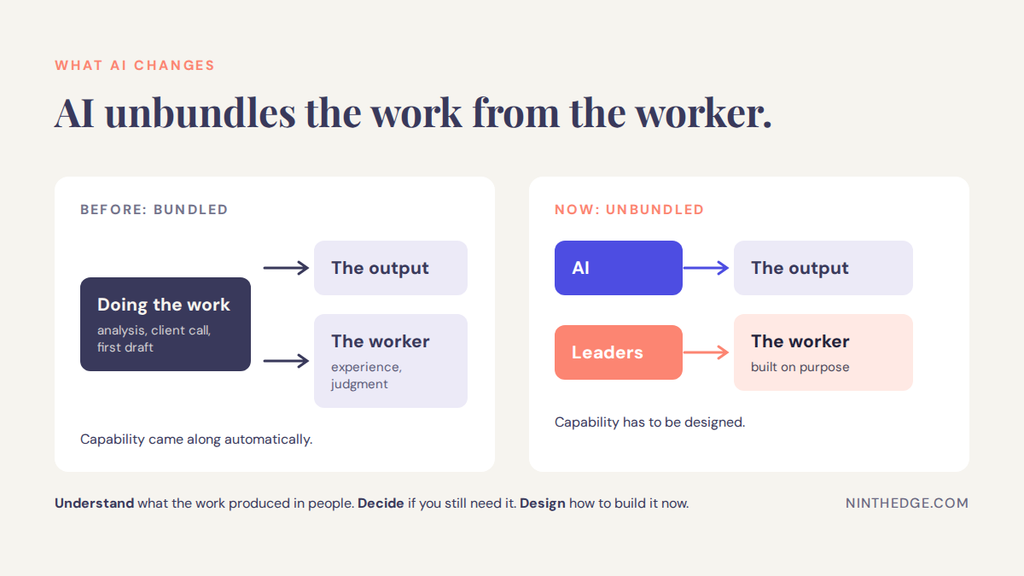
AI can increasingly produce the output without requiring the human experience that used to come with it. The analysis gets built. The draft gets written. And the person who would have learned from doing it doesn’t.
That matters more than it might seem. In a 2025 study in The Lancet Gastroenterology & Hepatology, experienced physicians who had been working with AI-assisted colonoscopy found precancerous growths less often when they later performed the procedure without the AI. Detection rates fell from 28.4% to 22.4%. These were veterans, each with more than 2,000 procedures behind them. When the tool carried part of the work, part of the capability quietly went with it.
This is not an argument for protecting old work
It would be easy to read that and conclude that we should keep people doing things the old way. That’s the wrong lesson.
When plumbing arrived, we didn’t keep hauling water because it made people strong. We built better ways to build strength. Gyms, training programs, and coaching are more deliberate and more effective than carrying buckets ever was.
Some of the pathways that used to build capability at work are like that. They’re vestigial. People learned from them because there was no alternative, not because they were the best way to learn.
AI can make the alternative real. When researchers from Stanford and MIT studied more than 5,000 customer support agents who were given an AI assistant, productivity rose 14% on average and 34% for newer and less experienced agents. The AI spread the practices of the best performers and helped new people move up the experience curve faster than they would have on their own.
That’s the opportunity. If AI clears away low-value work, people can take on harder problems earlier, get more reps, receive faster feedback, and carry consequential responsibility sooner. That’s potentially a better developmental system than the one we had.
But it won’t build itself. Once work no longer develops people automatically, someone has to do it on purpose.
The real leadership challenge
So the leadership challenge isn’t “protect the old work.” It’s three moves:
- Understand what the work was producing in people. Be specific. Judgment about pricing? Comfort with conflict? A feel for what the client won’t say out loud?
- Decide whether you still need it. Some capabilities matter more than ever. Others are artifacts of how work used to get done, and it’s fine to let them go.
- Design the best way to produce it now. If the capability still matters, don’t leave it to chance. Build the reps, the feedback, and the stretch assignments that develop it, often faster than the old work did.
Efficiency asks, “Can we remove the work?”
Leadership asks, “What should replace it?”
Both questions matter. AI is going to make a lot of work faster, cheaper, and better, and we’re for that. But efficiency only accounts for the output. Leadership has to account for the worker, too.
A practical tool: DECID
Once you know what capability you’re trying to build, the next decision is what role AI should play. We’ve been testing a simple tool with clients. It’s a working version, and we expect it to change.
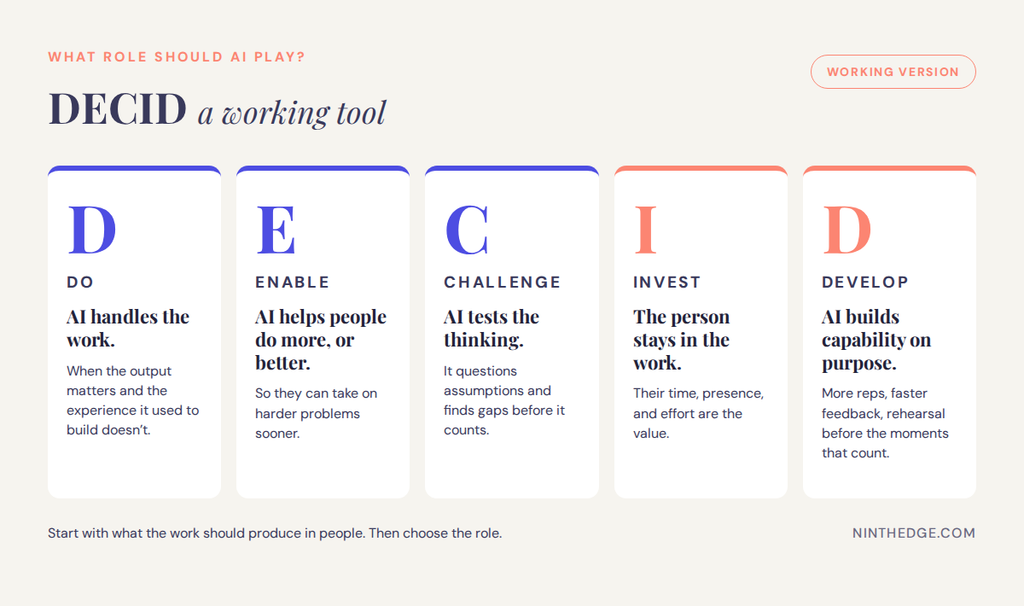
- Do: AI handles the work. Right when the output matters and the experience it used to build doesn’t.
- Enable: AI helps people do more, or better, work than they could alone, so they can take on harder problems sooner.
- Challenge: AI questions assumptions, finds gaps, and stress-tests thinking before it reaches a client or a boardroom.
- Invest: The person deliberately stays in the work because their time, presence, and effort are the value. Trust, relationships, and the calls people need to see a leader make.
- Develop: AI is used on purpose to build capability: more practice, faster feedback, and rehearsal before the moments that count.
The value of the tool isn’t the labels. It’s that it moves the conversation from “Should we use AI here?” to “What are we trying to produce in this work, and in this person?”
The intentional part
AI will take on more of the work, and that’s good news if leaders are deliberate about it. The organizations that get the most from AI won’t be the ones that automate the most. They’ll be the ones that understand what their work was quietly building in people, and find better ways to build it.
We’re still testing and refining this thinking, and we’d like to hear from you: What’s one piece of work AI is beginning to take off your team’s plate, and what, if anything, were people learning by doing it? Reach out through ninthedge.com/contact.
Sources: Budzyń et al., “Endoscopist deskilling risk after exposure to artificial intelligence in colonoscopy,” The Lancet Gastroenterology & Hepatology, August 2025. Brynjolfsson, Li and Raymond, “Generative AI at Work,” The Quarterly Journal of Economics, 2025.
The Measurement Problem: Why Leadership Development Struggles to Prove Its Impact
There is a question that follows almost every leadership development program. Not during the program. Not in the feedback…

Your Team Is Functional. That’s the Problem.
Let’s Start With What You’re Seeing You have a team that delivers. Deadlines get met. Projects move forward. By…

Why Leadership Programs Don’t Stick — and How to Design Ones That Do
Last month, we looked at how always-on cultures make burnout predictable — not because of poor intent, but because…